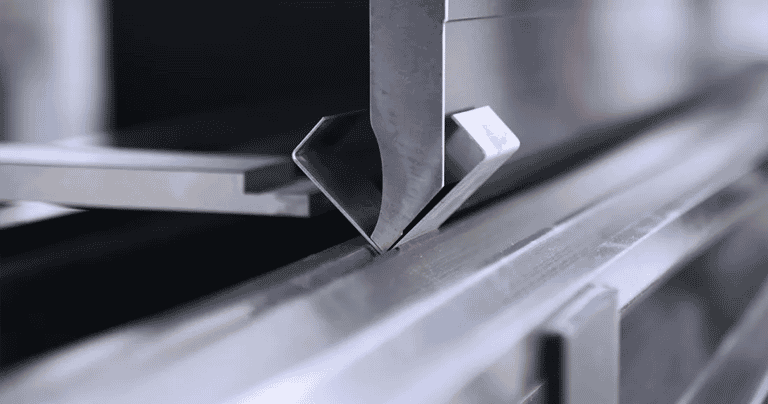
In the sheet metal fabrication industry, precision is everything. Whether you are bending 2mm mild steel for electrical enclosures or 10mm thick stainless steel for heavy construction machinery, operating a CNC press brake requires exact calculations.
One of the most critical parameters you must determine before hitting the foot pedal is the bending force, commonly known as press brake tonnage.
Guessing this number doesn’t just lead to inaccurate bend angles—it can cause catastrophic damage to your press brake tooling, deform the machine’s ram, and create severe safety hazards in your workshop. In this guide, we will break down how bending tonnage is calculated and introduce a powerful free tool to make your daily operations easier.
Why Accurate Tonnage Calculation is Critical
Many novice operators rely on “feel” or outdated wall charts, but modern fabrication demands precision. Here is why you need to calculate your required tonnage for every new job:
- Protecting Your Machinery: Every hydraulic press brake machine and electric press brake has a maximum rated tonnage. Consistently pushing a machine near or beyond its limit will wear out hydraulic seals, damage servo motors, and cause permanent deflection in the machine frame.
- Preserving Tooling Life: Press brake dies and punches are expensive. Applying 200 tons of force on a V-die rated for only 100 tons per meter will cause the die to split or shatter, leading to costly replacements and dangerous shrapnel.
- Ensuring Bending Accuracy: Bending force directly affects the inside radius (Ri) and the springback of the material. If your tonnage is miscalculated, achieving a perfect 90-degree bend becomes a frustrating process of trial and error.
The Core Variables of Bending Force
To determine how much force you need, you must understand the four primary variables in the air bending process:
- Sheet Thickness (S): The thicker the plate, the more force is required. Force increases exponentially with thickness.
- Bending Length (L): Tonnage is directly proportional to the length of the bend. Bending a 3-meter sheet requires exactly three times the force of bending a 1-meter sheet of the same material.
- V-Die Opening (V): A wider V-opening reduces the required bending force because it increases the leverage. However, a wider V-die also increases the inside bend radius. (Rule of thumb: V should be 6 to 8 times the material thickness).
- Material Tensile Strength: Mild steel is the standard. Aluminum requires less force, while high-tensile materials like stainless steel demand about 50% more tonnage.

The Universal Press Brake Tonnage Formula
For decades, engineers have used a standard empirical formula to calculate air bending force:
$F = (65 \times S^2 \times L) / V \times C$
(Where F = Force in Tons, S = Thickness in mm, L = Length in meters, V = V-opening in mm, and C = Material Coefficient).
While doing this math manually with a calculator is possible, it is time-consuming and leaves room for human error—especially in a fast-paced production environment.
Meet the KRRASS Free Press Brake Tonnage Calculator
To help our global partners and fabrication shops work smarter, the KRRASS engineering team has developed a highly accurate, easy-to-use digital tool:
👉 Try the Free KRRASS Press Brake Tonnage Calculator Here
With our online calculator, you simply select your material, input the sheet thickness and bend length. Instantly, the system will provide you with:
- The optimal V-Die Opening for your specific thickness.
- The exact Bending Force (Tonnage) required for the job.
Smart Machinery Recommendations:
What makes the KRRASS calculator unique is its intelligent recommendation engine. Once your required tonnage is calculated, the tool automatically suggests the most suitable KRRASS machinery for your needs with a safe operational margin—whether it is an agile 63-Ton CNC Press Brake or a heavy-duty 400-Ton industrial powerhouse.
Ready to Upgrade Your Fabrication Capabilities?
Knowing your tonnage is the first step; having the right equipment to deliver that force consistently is the next. If your current calculations show that you are constantly maxing out your old mechanical press brake, it might be time for an upgrade.
Explore the full range of KRRASS CNC Press Brakes, featuring advanced hydraulic and servo-electric technologies designed for maximum precision, energy efficiency, and safety.
Calculate your tonnage today, and bend with confidence! To learn more about our bending machine products, please visit our YouTube channel to watch related videos about CNC Press Brakes.
Share