





All Information at Your Fingertips
Quotes, part programs, technology settings, reports, and production progress stay available in digital form for faster planning and review.
KRRASS connects machines, software, work orders, reporting, and support channels so fabrication teams can monitor production in real time and move from design to finished parts with less friction.

Machine data, production planning, ERP communication, reporting, and service support connected in one digital layer.
Industry 4.0 is useful only when the information helps operators, planners, and service teams make faster decisions. The KRRASS approach brings machine status, job data, part history, warehouse inputs, ERP communication, and maintenance signals into one practical production view.
Quotes, part programs, technology settings, reports, and production progress stay available in digital form for faster planning and review.
Traceability links parts, processes, batches, and finished-product history so production can be checked by order, material, program, and machine.
When production changes, connected planning keeps machines and software synchronized so operators can adjust work without losing the full process view.
Industrial IoT signals help reduce downtime, wasted material, idle equipment, and disconnected decisions across the fabrication line.
Read-only OPC-UA machine monitoring for real-time status and productivity data
Interconnected machine workflows across cutting, bending, handling, and automation
ERP and WebServices communication for work orders, batches, warehouse stock, and reports
Open dashboards for shop-floor screens, mobile review, and production-history analysis
Remote support, augmented-reality service, and maintenance signals that reduce unexpected stops
The production layer follows the same route highlighted by the reference page: listen to the machine, connect related technologies, plan from materials and work orders, then let ERP and dashboards close the loop.
OPC-UA status and productivity data let teams watch machine operation in real time while keeping the machine data flow read-only.
Connected machines can work as one production system instead of isolated islands for cutting, bending, handling, and automation.
Work orders, production batches, material availability, and warehouse consumption can be planned from the same digital workflow.
WebServices-style interfaces let business systems send work orders, receive reports, automate process steps, and analyze finished output.
The same connected layer helps after installation: service teams can diagnose faster, users can share what they see, and maintenance can move from reaction toward prevention.
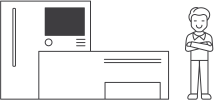
When a critical issue appears, authorized service can connect securely, review the machine situation, and guide troubleshooting without waiting for a site visit.
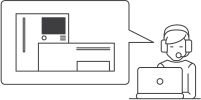
Smartphone, tablet, or PC communication lets the operator show the machine condition clearly, so support can explain the next action with less guesswork.

Machine performance data and maintenance recommendations help teams prevent avoidable failures and keep system availability under control.