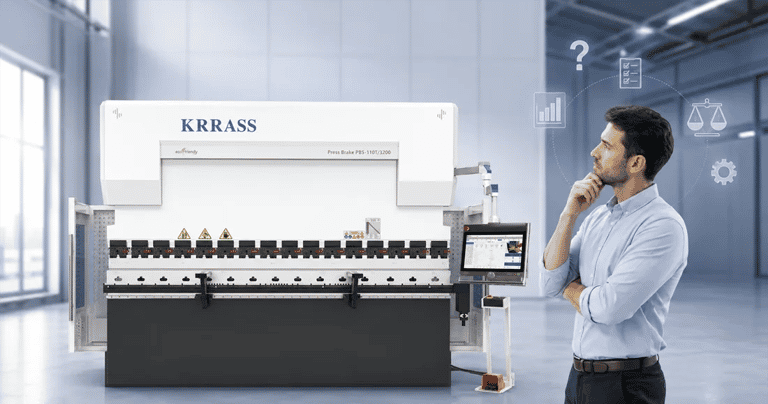
A press brake machine is one of the most important machines in modern sheet metal fabrication. It bends flat sheet metal into accurate angles and profiles by pressing the material between an upper punch and a lower die. For factories that manufacture electrical cabinets, machine covers, brackets, elevator panels, HVAC ducts, construction equipment parts, stainless steel enclosures, or custom sheet metal components, the press brake is often a central production machine rather than a simple auxiliary tool.
Choosing the right press brake machine is not only a question of tonnage. A buyer must also evaluate bending length, material type, sheet thickness, V-die opening, controller level, back gauge axes, tooling style, crowning compensation, safety system, hydraulic components, servo systems, operator workflow, future production mix, and long-term service support. Two machines may both be called a 110-ton 3200 mm press brake, but their performance can be very different if one has a basic controller and manual tooling while the other has a multi-axis CNC back gauge, CNC crowning, high-precision scales, advanced safety protection, and a well-matched tooling package.
This guide is written for factory owners, production managers, engineers, purchasing teams, and metal fabrication professionals who are evaluating a press brake machine for sale. It explains what a press brake machine is, how it works, which types are available, what specifications matter, how to estimate bending force, how to select tooling, and how to prepare a more accurate inquiry before asking a manufacturer for a quotation.
The goal is simple: help you start from your parts and production requirements, not from a machine label alone.
Editorial note for buyers: The examples in this article are general engineering guidance for press brake selection. Final machine sizing should always be checked against your actual drawings, material standards, tooling load ratings, local safety requirements, and the manufacturer’s technical proposal.
Table of Contents
What Is a Press Brake Machine?
A press brake machine is a sheet metal bending machine used to form metal sheets into angles, channels, boxes, pans, frames, brackets, and other profiles. It uses controlled force to press a workpiece between a punch and die. The upper tool is usually called the punch, and the lower tool is called the die. The die usually has a V-shaped opening, although other die shapes are also used for special forming operations.
In practical production, a press brake machine is not only used to make a single 90-degree bend. It can produce multiple bends on one part, handle different flange sizes, support different bend angles, and work with segmented tooling for box-shaped parts. With the right tooling and CNC controller, one machine can process a wide range of part geometries.
Typical materials processed on press brake machines include mild steel, stainless steel, aluminum, galvanized steel, pre-painted steel, copper, brass, and some high-strength materials. Each material behaves differently during bending. For example, stainless steel usually requires more force and shows more springback than mild steel. Aluminum may be easier to bend but can crack if the bend radius is too tight or the grain direction is not considered.
A press brake machine is commonly used after cutting. A production flow may start with a fiber laser cutting machine, shearing machine, punching machine, or plasma cutting machine. The blank is then transferred to the press brake for bending. After bending, the part may go to welding, grinding, powder coating, assembly, or inspection.
Press Brake Machine vs. Brake Press Machine
The standard industry term is press brake or press brake machine. Some buyers search for “brake press machine,” “brake press,” or even “press break machine.” These terms are common search variations, but they are less technically precise. In professional sheet metal fabrication, “press brake machine” is the preferred term.
From an SEO and buyer-education perspective, it is useful to mention these variations in FAQ sections, but a professional product page should use the correct term: press brake machine.
How a Press Brake Machine Works

The working principle of a press brake machine can be explained in a simple sequence: positioning, clamping, bending, return, and part handling. However, achieving accurate bends repeatedly requires careful control of many variables.
First, the operator or CNC controller prepares the bending program. A basic program may include the material thickness, bending angle, flange size, back gauge position, tool data, and stroke depth. Advanced CNC controllers can store part programs, calculate bend sequences, display tool setups, and help the operator reduce trial bends.
Second, the sheet metal is positioned against the back gauge. The back gauge is the reference system that determines where the bend line will be placed. A simple machine may use a basic X-axis back gauge. A more advanced CNC press brake may use X, R, Z1 and Z2 axes to position different flanges and support complex bending sequences.
Third, the ram moves downward and drives the punch into the material. The sheet is pressed into the die opening. The final angle depends on punch depth, tooling geometry, material thickness, material strength, springback, and the bending method.
Fourth, the ram returns to the open position. The operator removes the part or rotates it for the next bend. For high-mix production, the time spent between bends and between jobs can be just as important as the bending speed itself.
Major Bending Methods
Most press brake operations fall into three main bending methods: air bending, bottom bending, and coining. Each method has its own advantages and limitations.
| Bending Method | How It Works | Advantages | Limitations | Typical Use |
|---|---|---|---|---|
| Air bending | The material contacts the punch tip and both shoulders of the V-die, but it does not fully bottom out. | Flexible angle control, lower tonnage, widely used with CNC control. | More springback; requires good material and depth control. | General sheet metal fabrication and varied part production. |
| Bottom bending | The material is pressed closer to the bottom of the die. | More predictable angles in some applications. | Requires more tonnage and closer tooling matching. | Repeated parts with specific angles and materials. |
| Coining | Very high force is used to force the material into the die geometry. | Reduces springback and improves angle consistency. | Requires very high tonnage and creates more tool load. | Special precision applications, less common for general fabrication. |
Air bending is the most common method in modern fabrication because it offers flexibility. A factory can often use the same tooling to produce different angles by changing the ram position. This is one reason CNC press brakes have become so important: repeatable axis control and compensation functions help air bending remain accurate across many jobs.
Main Types of Press Brake Machines
Not every press brake machine is designed for the same type of production. Before choosing a model, buyers should understand the major machine types and the production scenarios they serve.

Hydraulic Press Brake
A hydraulic press brake uses hydraulic cylinders to move the ram and generate bending force. It is one of the most widely used press brake types in sheet metal fabrication because it offers strong capacity, mature technology, flexible configuration, and a wide tonnage range.
A hydraulic press brake is suitable for factories that need stable bending capacity for medium and heavy sheet metal parts. It can be configured as a basic NC machine or as a high-performance CNC hydraulic press brake with servo-hydraulic synchronization, linear scales, CNC crowning, multi-axis back gauge, and advanced controller options.
A hydraulic press brake is often a strong choice when the factory needs:
- Medium to high tonnage capacity
- Long bending length options
- Stable forming of mild steel, stainless steel, and aluminum
- Flexible tooling and controller choices
- A good balance between investment cost and capability
- Custom configurations for different production requirements
The main considerations are hydraulic maintenance, oil temperature control, sealing condition, hydraulic valve quality, synchronization accuracy, and long-term service support.
CNC Press Brake
A CNC press brake is controlled by a computer numerical control system. The term “CNC” describes the control level, not necessarily the power source. Many CNC press brakes are hydraulic, while some are servo-electric or hybrid machines.
A CNC press brake can control ram movement, back gauge position, crowning compensation, and sometimes additional axes. It can store part programs, reduce setup time, and support more consistent production. For factories producing multiple part types, CNC control can reduce dependence on one highly experienced operator.
A CNC press brake is suitable when the buyer needs:
- Repeatable bending accuracy
- Faster setup for different jobs
- Multi-bend parts
- Complex flanges and box-shaped parts
- Digital program storage
- Better operator guidance
- Higher productivity in small and medium batches
Controller selection is important. Entry-level controllers may be suitable for basic bending, while advanced 2D or 3D graphical controllers can help with bend sequence planning, collision checking, tooling setup, and production efficiency. For example, Delem states that its DA-69S controller supports 2D and 3D programming, automatic bend sequence calculation, collision detection, and full 3D machine setup. Buyers who process complex parts should evaluate this level of control carefully.
NC Press Brake
An NC press brake is a more basic numerically controlled machine. Many NC press brakes use torsion bar synchronization, where the left and right sides of the ram are mechanically linked. NC press brakes are usually more affordable than advanced CNC machines and can be suitable for simple bending jobs.
An NC press brake may be a reasonable choice when:
- The part structure is simple
- Tolerance requirements are moderate
- Production batches are not highly varied
- The buyer has a limited budget
- The operator has strong bending experience
However, NC press brakes usually provide less automation, less flexibility, and lower setup efficiency than CNC press brakes. If the factory plans to process more complex parts or improve repeatability, a CNC press brake is usually a better long-term investment.
Pure Electric Press Brake
A pure electric press brake uses servo motors and mechanical transmission instead of a traditional hydraulic system. It does not use hydraulic oil for ram movement. This can reduce energy consumption, noise, oil leakage risk, and hydraulic maintenance.
Pure electric press brakes are often suitable for small and medium tonnage applications, precision sheet metal work, electrical cabinets, stainless steel enclosures, high-mix production, and factories that care about clean manufacturing.
Advantages may include:
- Lower energy consumption during standby and partial load
- Clean operation without hydraulic oil leakage
- High repeatability
- Fast acceleration and response
- Lower noise level
- Reduced hydraulic maintenance
The limitation is that pure electric machines may not be the best choice for very heavy plate bending. For high-tonnage and long-length applications, hydraulic press brakes remain widely used.
Hybrid Servo Press Brake
A hybrid servo press brake combines hydraulic force with servo-driven efficiency. It may use servo motors to control hydraulic pump output, reducing energy waste compared with traditional constant-speed hydraulic systems. Hybrid systems can be useful when a buyer wants the strength of hydraulics with better energy efficiency and control response.
The exact design varies by manufacturer, so buyers should compare hydraulic circuits, servo pump configuration, cooling requirements, maintenance access, and control strategy.
Machine Type Comparison Table
| Machine Type | Best For | Main Advantages | Main Limitations | Buyer Profile |
|---|---|---|---|---|
| Hydraulic press brake | General to heavy sheet metal bending | Strong capacity, flexible sizes, mature technology | Requires hydraulic maintenance | Fabrication factories with varied materials and thicknesses |
| CNC press brake | Accurate and repeatable production | Digital control, multi-axis options, stored programs | Higher initial cost than basic NC | Factories with complex parts or frequent job changes |
| NC press brake | Simple bending and budget-sensitive projects | Lower cost, simpler structure | Lower automation and flexibility | Factories with simple parts and experienced operators |
| Pure electric press brake | High-precision thin to medium sheet bending | Clean, quiet, energy efficient | Limited heavy-tonnage suitability | Precision sheet metal and high-mix production |
| Hybrid servo press brake | Energy-conscious medium to heavy bending | Hydraulic strength plus servo efficiency | Configuration depends on manufacturer | Buyers seeking balance between power and efficiency |
Key Specifications to Check Before Buying
A professional press brake purchase should be based on real production requirements. The following specifications should be checked before selecting a machine.
Tonnage
Tonnage is the maximum bending force the machine can generate. It should match the material, thickness, bending length, and tooling. Insufficient tonnage can cause incomplete bends, unstable angles, overload conditions, or damage to the machine and tooling. Excessive tonnage may increase cost and can also create risk if tooling load ratings are ignored.
Bending Length
Bending length is the maximum length the machine can bend. Common bending lengths include 1600 mm, 2500 mm, 3200 mm, 4000 mm, and 6000 mm. A 3200 mm press brake is common in many factories, but long panels may require 4000 mm or 6000 mm machines.
The buyer should not simply choose the longest machine available. Longer machines cost more, require more floor space, and need better deflection compensation. The better method is to check the longest part you actually need to bend and leave reasonable future capacity.
Open Height, Stroke and Throat Depth
Open height affects how much space is available between the punch and die when the ram is open. Stroke determines how far the ram can travel. Throat depth affects how far the sheet can extend into the machine frame.
These specifications matter for deep boxes, tall flanges, return bends, and parts that require special tooling. A machine may have enough tonnage but still be unsuitable if the open height or throat depth is too limited.
Back Gauge Axes
The back gauge determines the bend position. A simple X-axis back gauge may be enough for basic bends, while R, Z1, and Z2 axes can improve flexibility for complex parts. Multi-axis back gauges reduce manual adjustment and help operators handle different flange positions more efficiently.
Controller Level
The controller affects programming speed, operator training, error reduction, and production repeatability. Entry-level controllers are suitable for simple jobs. Graphical 2D and 3D controllers can help with bend sequence, tooling layout, and collision avoidance.
Delem’s official DA-53Tx description, for example, describes a touch control solution for synchronized press brakes and notes standard capability for controlling up to four axes. Higher-level controllers may offer more advanced visualization and programming functions.
Crowning System
Crowning compensates for frame and ram deflection during long bends. Without crowning, a long workpiece may bend differently in the middle than at the ends. This problem is often called the “canoe effect.”
Crowning systems may be manual, mechanical, hydraulic, or CNC-controlled. For long bending length and tight angle tolerance, CNC crowning can be especially valuable because it allows compensation to be adjusted based on the job.
Tooling Standard and Clamping
Tooling compatibility affects future flexibility. Common systems include European style tooling, American style tooling, and other manufacturer-specific standards. Buyers should confirm the tooling standard, clamping type, tool segmentation, tool height, and availability of replacement tools.
Fast and accurate tool changing can be important for high-mix production. WILA, for example, describes its clamping systems as supporting fast and safe tool changes, with benefits for accuracy and productivity. Whether a buyer uses WILA style tooling, European tooling, or another system, the clamping strategy should match production reality.
Safety System
A press brake creates a dangerous point of operation. Safety must be evaluated as part of the machine specification, not as a last-minute accessory. Guarding, laser safety, light curtains, emergency stops, rear guarding, interlocks, safety PLCs, and safe operation procedures all matter.
In the United States, OSHA 29 CFR 1910.212 requires machine guarding methods to protect operators and other employees from hazards such as point of operation hazards, ingoing nip points, rotating parts, flying chips, and sparks. OSHA also explains that the point of operation is the area where work is performed on the material. International buyers should also consider relevant local standards and factory audit requirements.
Press Brake Tonnage and Bending Force
Tonnage selection is one of the most important parts of press brake buying. If the tonnage is too low, the machine may not bend the part properly. If the tonnage is too high for the tooling or application, it can create unnecessary cost and safety risk.
Bending force depends mainly on:
- Material tensile strength
- Material thickness
- Bending length
- V-die opening
- Bending angle
- Bending method
- Tooling radius and die geometry
- Grain direction and material condition
A simplified air bending formula often used for planning mild steel bending is:
P ≈ 650 × t² × L ÷ V
Where:
Pis approximate bending force in kNtis material thickness in mmLis bending length in metersVis V-die opening in mm
This formula is useful for preliminary planning, but it should not be treated as a final engineering certificate. Stainless steel, high-strength steel, aluminum, non-standard radii, tooling limits, and machine load distribution require correction. Tooling load ratings and manufacturer recommendations must be checked.
Example Calculation
If a factory wants to air bend 4 mm mild steel over a length of 3 meters with a 32 mm V-die opening:
P ≈ 650 × 4² × 3 ÷ 32
P ≈ 650 × 16 × 3 ÷ 32
P ≈ 975 kN
This means the job requires approximately 975 kN, or about 99 metric tons, under this simplified assumption. In practice, a buyer would add a safety margin, check material data, check tooling rating, and confirm the calculation with the manufacturer.
Preliminary Tonnage Planning Table
| Buyer Input | Why It Matters | Example |
|---|---|---|
| Material | Different tensile strengths require different force. | Mild steel, stainless steel, aluminum |
| Thickness | Force increases quickly as thickness increases. | 2 mm, 4 mm, 8 mm |
| Bending length | Longer bends require more total force. | 1000 mm, 3200 mm, 6000 mm |
| V-die opening | Larger openings usually reduce force but increase inside radius. | 16 mm, 32 mm, 50 mm |
| Bend angle | Acute angles and special forming may need more force. | 90 degrees, 120 degrees, hemming |
| Tooling load rating | Tools have maximum allowable load. | Confirm with tooling supplier |
| Production margin | Prevents overload and supports future work. | 15-30% margin depending on application |
For a more reliable selection, buyers should prepare drawings and material data before requesting a quotation.
Of course, you can also visit KRRASS’s online tonnage calculator page to directly calculate the required equipment tonnage for the metal sheet you want to bend.
Tooling Selection: Punches, Dies and V-Die Opening

A press brake machine cannot perform well without suitable tooling. Tooling determines bend radius, flange feasibility, surface marking, angle consistency, and forming capability. Many bending problems are not caused by the machine itself but by poor tooling selection.
Common Press Brake Punches
A punch is the upper tool that contacts the material from above. Common punch types include:
| Punch Type | Typical Use | Notes |
|---|---|---|
| Standard punch | General 90-degree bending | Common for many sheet metal jobs |
| Acute punch | Smaller included angles | Useful for acute bends and springback compensation |
| Gooseneck punch | Deep boxes and return flanges | Provides clearance for formed parts |
| Radius punch | Larger inside radius | Useful when sharp bends may crack the material |
| Flattening punch | Hemming operations | Used with hemming dies or special setups |
| Segmented punch | Box and pan forming | Allows flexible positioning for closed shapes |
Common Press Brake Dies
The die is the lower tool. The most common die is a V-die. Other dies are used for special forming.
| Die Type | Typical Use | Notes |
|---|---|---|
| Single V die | General bending | One V opening per die |
| Double V die | Two V openings | More flexibility without changing die body |
| Multi-V die | Multiple V openings | Convenient for varied thicknesses |
| 4-way die | Heavy and varied bending | Rotated to use different openings |
| Urethane die | Reduced surface marking | Useful for sensitive materials |
| Hemming die | Flattened hems | Used for safety edges or double-thickness edges |
| Radius die | Large-radius bends | Used with radius punch or special forming |
V-Die Opening Selection
The V-die opening affects tonnage, inside radius, flange length, and bend quality. A common starting point for air bending mild steel is to use a V opening around 6 to 10 times the material thickness, with 8 times thickness often used as a practical reference. This is not a universal rule. Thin stainless steel, soft aluminum, thick plate, high-strength steel, and special surface requirements may require different choices.
A smaller V opening can create a smaller inside radius, but it increases required tonnage and may cause marks or cracking. A larger V opening reduces force but increases the inside radius and minimum flange requirement.
Tooling Selection Checklist
| Question | Why It Matters |
|---|---|
| What material and thickness will be bent most often? | Determines V opening, punch radius, and tool load. |
| What is the minimum flange length? | A wide V opening may not support short flanges. |
| Is the part a box or channel? | May require gooseneck or segmented tooling. |
| Is surface marking allowed? | Stainless and painted sheets may need protective film or urethane dies. |
| Is hemming required? | Requires special hemming tools and enough tonnage. |
| Are tools shared across machines? | Tooling standard and height must be checked. |
| How often will tools be changed? | Fast clamping may save significant setup time. |
Tooling should be discussed at the same time as the machine. A strong machine with the wrong tooling package will still produce poor results.
Back Gauge, Crowning and Controller Options
Modern press brake performance depends heavily on positioning, compensation, and programming.
Back Gauge
The back gauge positions the material before each bend. A stable back gauge reduces errors and increases repeatability. Important features include servo motor drive, ball screw transmission, linear guide rails, strong back gauge fingers, and easy calibration.
A basic X-axis back gauge controls front-to-back movement. R-axis control moves the back gauge up and down, useful when the flange height or tooling setup changes. Z1 and Z2 axes move fingers left and right, useful for asymmetric parts, tapered parts, and different bend positions.

Crowning
During long bending, the ram and bed can deflect. If this deflection is not compensated, the angle at the center of a long part can differ from the angle near the ends. Crowning creates a controlled compensation curve so the forming depth remains more consistent across the length.
Manual shimming may work for occasional correction, but it is slow and depends heavily on operator experience. Mechanical crowning and hydraulic crowning are better for repeatable production. CNC crowning is especially useful when the machine frequently changes materials, thicknesses, and lengths.
Controller
The controller is the operator’s interface with the machine. It affects programming speed, bend sequence, axis control, and setup confidence. A basic controller may be suitable for simple work, but complex parts benefit from graphical programming and simulation.
A controller should be evaluated by asking:
- Can operators program parts easily?
- Does it support the required axes?
- Can it store tooling data?
- Does it support bend sequence planning?
- Does it help with crowning and angle correction?
- Does it support 2D or 3D visualization?
- Is the interface suitable for local operators?
- Are manuals and technical support available?
A press brake is a production machine. A controller that reduces setup time may produce a stronger return on investment than a slightly cheaper controller that slows operators every day.
Safety and Compliance Considerations

Press brake safety deserves special attention. A press brake applies high force at the point of operation, where the punch and die form the material. The risk is not theoretical. Fingers, hands, arms, and helpers can be exposed to serious crushing hazards if machine guarding and work procedures are not properly designed.
OSHA’s general machine guarding standard, 29 CFR 1910.212, requires one or more guarding methods to protect operators and other employees from hazards, including point of operation hazards. OSHA’s interpretation for power press brakes also identifies 29 CFR 1910.212 as the related standard for mechanical power press brakes and states that point-of-operation safeguarding is regulated under 1910.212(a)(3)(ii).
ANSI B11.3-2022 is a machine-specific standard for power press brakes. The ANSI webstore describes the standard as applying to machines classified as power press brakes that are designed and constructed for bending material. For machine design risk assessment, ISO 12100 provides basic terminology, principles, and methodology for risk assessment and risk reduction. For safety-related parts of control systems, ISO 13849-1:2023 provides requirements and guidance for safety-related control system design.
This article is not a legal compliance document, and requirements vary by country and application. However, a serious buyer should discuss safety early in the purchasing process.
Common Safety Features to Discuss
| Safety Feature | Purpose | Buyer Notes |
|---|---|---|
| Light curtain | Detects entry into hazardous area | Must be correctly positioned and integrated. |
| Laser safety system | Protects near the punch and die area | Often used on modern CNC press brakes. |
| Emergency stop | Allows rapid stop in emergency | Should be accessible and tested. |
| Safety foot pedal | Controls machine actuation | Should prevent unintended operation. |
| Rear guarding | Prevents access to back gauge area | Important when other workers may pass behind the machine. |
| Side guarding | Limits access from sides | Useful in crowded factories. |
| Safety PLC | Controls safety-related logic | Relevant to advanced safety functions. |
| Warning labels and manuals | Support operator awareness | Must be clear and language-appropriate. |
Safety Questions for Buyers
Before ordering a press brake, ask the supplier:
- What guarding options are available for this machine?
- Which safety devices are included as standard?
- Which safety devices are optional?
- Does the machine support laser guarding or light curtain integration?
- How is the rear area protected?
- Does the machine include a safety PLC?
- What documentation is provided for installation and operation?
- Can the supplier support safety configuration for your market?
- What local safety standard or audit requirement will your factory need to satisfy?
Common Applications by Industry
A press brake machine is used across many industries. The best machine configuration depends on the parts and production workflow.
| Industry | Typical Parts | Recommended Configuration Focus |
|---|---|---|
| Electrical cabinet manufacturing | Enclosures, doors, panels, brackets | CNC control, accurate back gauge, segmented tooling |
| HVAC and ventilation | Ducts, covers, frames | Flexible tooling, medium bending length, fast setup |
| Elevator and architectural metal | Stainless panels, decorative parts, frames | Surface protection, crowning, angle consistency |
| Automotive and transport | Brackets, covers, reinforcement parts | Repeatability, program storage, production efficiency |
| Construction machinery | Guards, covers, heavy brackets, structural plates | Higher tonnage, strong frame, heavy-duty tooling |
| Agricultural machinery | Covers, support parts, frames | Robust hydraulic machine, wide material range |
| Metal furniture | Cabinets, shelves, lockers, tables | CNC programming, segmented tooling, clean bends |
| Energy equipment | Cabinets, frames, mounting structures | Accuracy, documentation, repeatable production |
In real factory production, a press brake is rarely selected for only one part. Buyers should evaluate the full part family: the most common parts, the most difficult parts, and the parts expected in the next three to five years.
How to Choose the Right Press Brake Machine
The best press brake is not always the largest, the fastest, or the most expensive. It is the machine that matches your production parts, accuracy needs, workflow, operator skill level, and future growth plan.
Step 1: Start With Your Parts
Collect the drawings or samples of your main parts. Identify maximum thickness, maximum bending length, minimum flange length, bend angles, part shapes, material types, and tolerance requirements. If you do not have drawings, prepare photos and approximate dimensions.
Step 2: Confirm Material Range
Different materials need different force and tooling strategies. Mild steel, stainless steel, aluminum, galvanized sheet, and high-strength steel should not be treated the same. If your factory processes stainless steel frequently, tell the manufacturer clearly.
Step 3: Calculate Required Tonnage
Use your thickest and longest practical part to estimate bending force. Do not size the machine only for average parts if you frequently receive heavier jobs. At the same time, do not oversize blindly. The machine, tooling, and production workflow should be balanced.
Step 4: Select Bending Length
Choose a bending length based on your longest workpiece and future production plan. If most parts are below 2500 mm but occasional parts reach 3200 mm, a 3200 mm machine may be logical. If your factory often bends long panels, consider both machine length and crowning.
Step 5: Choose the Control Level
For simple repetitive work, a basic controller may be enough. For frequent job changes, multi-bend parts, and higher accuracy, a CNC controller with graphical programming may save time and reduce errors.
Step 6: Match Back Gauge Axes to Part Complexity
Simple flanges may only need an X-axis. Parts with different flange heights, complex bends, or asymmetric features may benefit from R, Z1, and Z2 axes. More axes increase cost, but they can also reduce setup time and operator mistakes.
Step 7: Select Tooling Early
Do not wait until after ordering the machine to discuss tooling. Punches, dies, segmented tools, gooseneck punches, hemming tools, and clamping systems should be selected according to the actual parts.
Step 8: Check Crowning Needs
If you bend long parts, crowning is not just an accessory. It can determine whether the angle remains consistent across the full length. Discuss mechanical, hydraulic, or CNC crowning depending on your budget and tolerance needs.
Step 9: Review Safety Configuration
Safety devices should match your factory layout, local standards, and operator workflow. Discuss light curtains, laser safety, rear guarding, interlocks, emergency stops, and documentation before finalizing the order.
Step 10: Evaluate Manufacturer Support
A press brake machine is a long-term investment. Choose a manufacturer that can support technical selection, machine testing, documentation, spare parts, operator training, and after-sales service.
Press Brake Machine Price Factors
Press brake machine price can vary widely because configuration affects cost. Two machines with the same nominal tonnage and length may have different prices because of controller level, back gauge axes, crowning system, hydraulic components, tooling package, safety system, and customization.
Main Cost Factors
| Cost Factor | Impact on Price | Practical Buyer Advice |
|---|---|---|
| Tonnage | Higher tonnage requires stronger frame, cylinders, and hydraulic system. | Size for real jobs with reasonable margin. |
| Bending length | Longer machines cost more and need more space. | Match the longest practical part, not only future dreams. |
| CNC controller | Advanced controllers increase cost but reduce setup time. | Choose based on part complexity and operator skill. |
| Back gauge axes | More axes increase automation and flexibility. | Use multi-axis systems for complex parts. |
| Crowning | CNC crowning adds cost but improves long-bend accuracy. | Essential for long panels and tight tolerances. |
| Tooling package | Special tools can significantly affect total cost. | Buy the tools required for real parts. |
| Safety system | Advanced guarding increases cost but protects operators. | Treat safety as part of machine value. |
| Hydraulic/servo system | Component quality affects stability and maintenance. | Ask for component brands and service access. |
| Customization | Special voltage, color, layout, or automation adds cost. | Clarify requirements early. |
| Shipping and installation | International delivery and commissioning affect total investment. | Include packaging, freight, training, and spare parts in budget. |
The cheapest press brake is not always the lowest-cost machine in real production. If a low-cost machine creates more scrap, longer setup, weak accuracy, limited tooling, or poor after-sales support, the real cost can become much higher.
Inquiry Form: Data to Prepare Before Requesting a Quote
A clear inquiry helps the manufacturer recommend the right press brake configuration. Buyers often ask, “What is your price for a press brake?” But without material, thickness, length, and part information, the supplier can only guess.
Use the following form before requesting a quotation.
| Inquiry Field | Your Data | Example |
|---|---|---|
| Main material | Mild steel, stainless steel, aluminum | |
| Maximum thickness | 4 mm stainless steel, 6 mm mild steel | |
| Maximum bending length | 3200 mm | |
| Common part length | 500-2500 mm | |
| Minimum flange length | 18 mm | |
| Required bend angles | 90 degrees, 135 degrees, hemming | |
| Monthly production volume | Small batch, medium batch, mass production | |
| Part drawings available? | Yes / No | |
| Accuracy requirement | +/-0.5 degrees, +/-0.2 mm flange tolerance | |
| Preferred controller | Delem, Cybelec, Estun, open to recommendation | |
| Required axes | 4+1, 6+1, 8+1, not sure | |
| Crowning required? | Mechanical / CNC / not sure | |
| Tooling required? | Standard tooling, gooseneck punch, segmented tools | |
| Safety requirement | Light curtain, laser safety, rear guarding | |
| Factory voltage | 380V 50Hz 3-phase, 220V 60Hz 3-phase | |
| Destination country | United States, Mexico, India, Saudi Arabia | |
| Installation support | Remote support / on-site commissioning |
Sample Request Message
You can send a message like this to a press brake manufacturer:
We are looking for a CNC press brake machine for sheet metal bending. Our main materials are mild steel and stainless steel. The maximum thickness is 6 mm mild steel and 4 mm stainless steel, and the maximum bending length is 3200 mm. We mainly produce electrical cabinet panels, brackets, and machine covers. Please recommend suitable tonnage, bending length, controller, back gauge axes, crowning system, safety options, and tooling package. We can provide drawings for technical evaluation.
This kind of inquiry allows the manufacturer to give a more accurate proposal instead of a generic price.
Why Choose KRRASS as Your Press Brake Machine Manufacturer?
KRRASS focuses on sheet metal forming equipment for global customers. The product range includes press brake machines, hydraulic shearing machines, fiber laser cutting machines, ironworker machines, and other metal forming solutions. For press brake buyers, KRRASS can help evaluate machine size, tonnage, controller, back gauge, tooling, safety configuration, and production application.
KRRASS can support different press brake requirements, including CNC press brakes, hydraulic press brakes, NC press brakes, pure electric press brakes, and customized bending solutions. Instead of only offering a standard model name, KRRASS can help buyers review the production requirements behind the machine.
KRRASS Press Brake Selection Support
| Selection Area | How KRRASS Can Support Buyers |
|---|---|
| Tonnage selection | Evaluate material, thickness, bending length, and V-die opening. |
| Machine length | Recommend suitable bending length based on actual part sizes. |
| Controller | Help compare controller levels for programming and production needs. |
| Back gauge | Recommend suitable axes for part complexity. |
| Crowning | Select compensation method for long bending accuracy. |
| Tooling | Suggest punches, dies, V openings, segmented tools, and special tools. |
| Safety | Discuss guarding options and operation requirements. |
| Customization | Support voltage, controller, tooling, machine color, and configuration needs. |
| Delivery support | Provide machine testing, packing, shipping, and after-sales communication. |
A suitable press brake machine should help a factory reduce rework, shorten setup time, improve repeatability, and expand production capability. It should not be selected only by comparing the lowest price.
FAQ About Press Brake Machines
What is a press brake machine used for?
A press brake machine is used to bend sheet metal into angles and profiles. It is commonly used to produce cabinets, brackets, enclosures, ducts, panels, frames, covers, and structural sheet metal parts.
What is the difference between a hydraulic press brake and a CNC press brake?
A hydraulic press brake describes the driving system, while a CNC press brake describes the control system. Many modern CNC press brakes are hydraulic machines. A CNC hydraulic press brake uses hydraulic force for bending and CNC control for programming, positioning, and repeatability.
How do I choose the right press brake tonnage?
Choose tonnage based on material type, tensile strength, thickness, bending length, V-die opening, and bending method. It is best to calculate tonnage from real part data and confirm the result with the machine manufacturer and tooling supplier.
What is the best press brake machine for sheet metal bending?
For many factories, a CNC hydraulic press brake is a strong general-purpose choice because it offers reliable bending force, flexible programming, and good repeatability. For thin sheet and high-efficiency precision work, a pure electric press brake may also be suitable. The best machine depends on the parts.
What tooling is used on a press brake machine?
Common tooling includes standard punches, acute punches, gooseneck punches, radius punches, V dies, double V dies, multi-V dies, 4-way dies, hemming dies, and urethane dies. Tooling should match the material, thickness, bend angle, inside radius, flange size, and part shape.
How much does a press brake machine cost?
The cost depends on tonnage, bending length, CNC controller, axes, back gauge system, crowning, tooling package, safety devices, hydraulic components, customization, shipping, and service support. A quotation should be based on actual production data.
What is a press brake back gauge?
A back gauge is the positioning system that locates the sheet metal before bending. It controls the bend line position and improves repeatability. CNC back gauges can include X, R, Z1, and Z2 axes for more complex parts.
What is press brake crowning?
Crowning is a compensation method used to correct deflection of the ram and bed during bending. It helps keep the bend angle more consistent across long parts.
Is a used press brake a good choice?
A used press brake may have a lower purchase price, but buyers should carefully check frame condition, hydraulic system, controller, back gauge, tooling, safety devices, spare parts availability, and service history. For factories that need reliable accuracy, documentation, and after-sales support, a new CNC press brake may be a better long-term investment.
What information should I provide before requesting a press brake quote?
Provide material type, maximum thickness, maximum bending length, part drawings, accuracy requirement, production volume, preferred controller, safety requirements, tooling needs, and destination country. This allows the manufacturer to recommend a more accurate configuration.
Conclusion
A press brake machine is a major investment for any factory that bends sheet metal. The right machine can improve accuracy, reduce rework, support faster setup, and expand production capacity. The wrong machine can create problems such as insufficient tonnage, poor angle consistency, difficult tooling changes, slow operation, safety risks, and limited future capability.
When evaluating a press brake machine for sale, do not start with the machine label alone. Start with your parts. Confirm material, thickness, bending length, flange size, tolerance, production volume, tooling needs, and safety requirements. Then select tonnage, length, controller, back gauge axes, crowning, tooling, and safety configuration based on those facts.
KRRASS can help global buyers evaluate press brake machine requirements and recommend suitable sheet metal bending solutions. If you are planning to purchase a CNC press brake, hydraulic press brake, NC press brake, pure electric press brake, or customized bending machine, prepare your part information and request a technical proposal before making the final decision.
Share